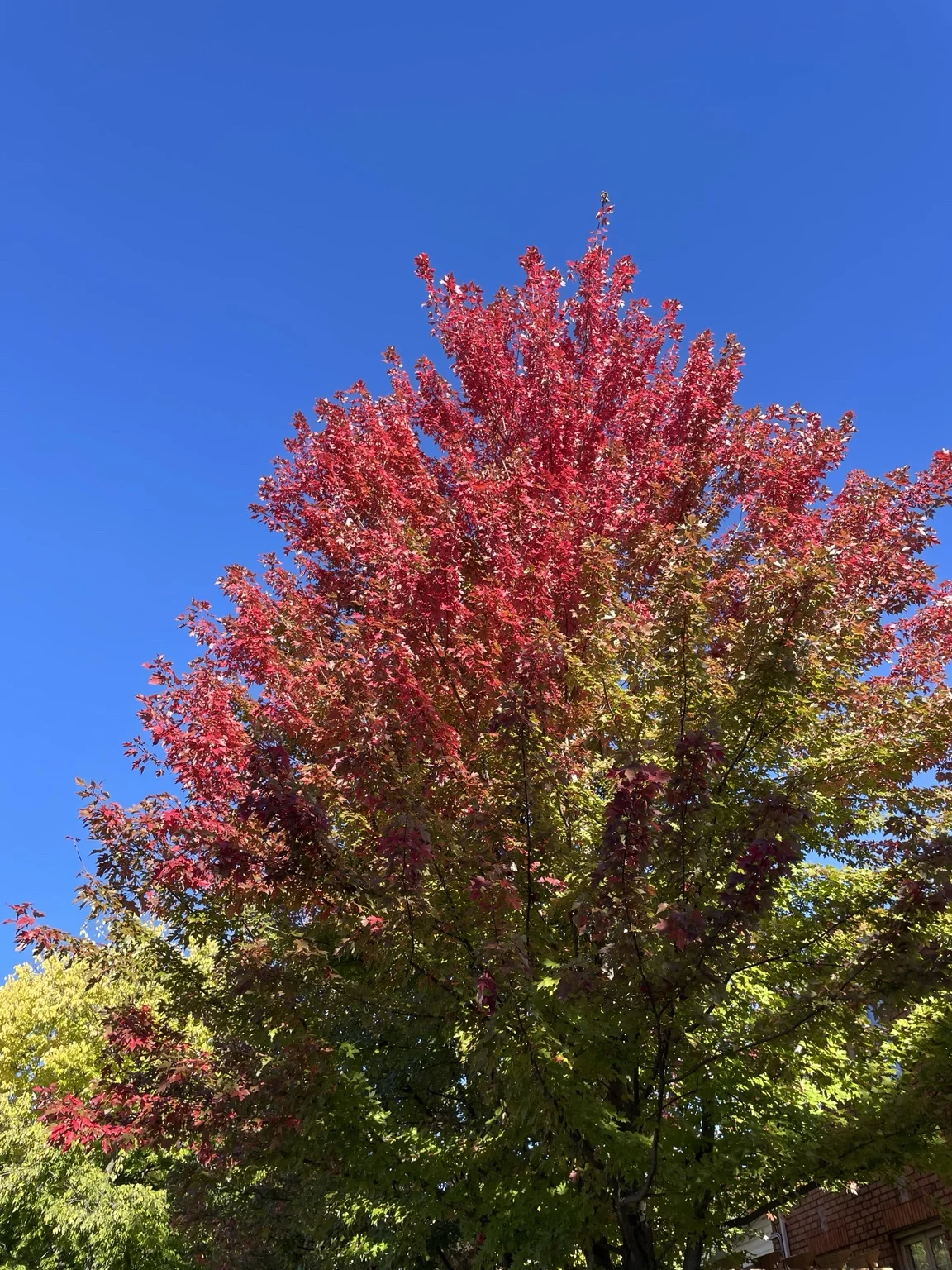
Today, the wind seemed to lull me to sleep.
The temperature had slipped a little from last week, settling into something more seasonal. Yet the sun was beautifully bright, bringing the crimson, oranges and yellows forward. Above them, the sky held that crisp blue I love so much.
There is something about this time of year. The air feels sharper, the colours more distinct. Even familiar trees ask for another look.
And somehow, amid all that brightness, I felt ready to rest.
I began wondering: what is it about autumn air that makes sleep feel so inviting?
Science offers a few threads to follow, although it cannot tell me precisely why I fell asleep today.
One begins with temperature. As we prepare for sleep, our core body temperature normally falls. Our bodies release heat through the skin, particularly the hands and feet. Interestingly, gently warming the skin can help this process along by encouraging heat loss. Comfort matters: excessive cold or heat can disturb sleep. A pleasantly cool setting may support rest, but an autumn breeze is not, by itself, a proven sleep signal.
Another thread is light. Our internal clock responds strongly to the changing pattern of daylight and darkness, helping regulate the evening rise in melatonin. Autumn brings earlier darkness, changing the light cues around us. Yet bright daylight generally suppresses melatonin, so my sleepy moment in the sunshine needs a more modest explanation. Our need for sleep also builds with the hours we spend awake.
Perhaps the day simply gave me an opportunity to notice tiredness that was already there.
Then there is the wind’s voice.
A review of research found that natural soundscapes were associated with reduced stress and annoyance, and improved positive feelings. This does not establish that rustling leaves send us to sleep. It does offer a plausible connection between the sounds of nature and feeling more at ease.
I recognise something of that in my own experience. The wind moving through the trees asks so little of me. I can listen without needing to answer. For a moment, my attention has somewhere gentle to settle.
Meanwhile, the leaves are undergoing changes of their own.
As green chlorophyll breaks down, yellow and orange pigments already present become more visible. Many trees also produce the anthocyanins responsible for autumn reds and purples. Sunny days and cool, frostless nights can help create those vivid displays we stop to admire.
I find that beautiful: the trees preparing for winter while the landscape briefly glows.
Knowing a little of the chemistry makes me look more closely. Knowing something about sleep makes me curious about the quiet conversation between my body and its surroundings.
I cannot say exactly what carried me into sleep today. Perhaps it was ordinary tiredness, comfortable air, or the pleasure of a season I love. Perhaps several things met at once.
What I do know is how it felt.
The sun brought the leaves into focus. The sky held its beautiful blue. The wind moved through it all.
And for a little while, it felt easy to rest.
What have you noticed in yourself as the season changes?
Sources and further reading
- Ichiba and colleagues (2020) — Periocular skin warming promotes body heat loss and sleep onset
- Okamoto-Mizuno and Mizuno (2012) — Effects of thermal environment on sleep and circadian rhythm
- NIH NICHD — What makes us sleep
- Buxton and colleagues (2021) — A synthesis of health benefits of natural sounds and their distribution in national parks
- Penn State Extension — The Science Behind Autumn Leaf Color
- NOAA — Cool autumn weather reveals nature’s true hues
Written and reflected upon by Diljeet K. Jandu